
“We do not wait for overwhelm to disappear before teaching skills, and we do not expect skills alone to make overwhelm disappear.
We address both together.”
— Mindful
Our Process
We teach executive functioning in the moments when students actually need it: when they are struggling to begin, reacting before they can think, avoiding something that feels overwhelming, recovering from a mistake, or trying again after a plan falls apart.
Using our Metacognitive Mentorship Model™, we help students work across several interconnected layers of executive functioning at once. We support the emotional regulation and flexibility needed to stay engaged, while also teaching the practical skills required to plan, organize, manage time, sustain attention, and follow through.
That means we use planners, calendars, checklists, routines, reminders, and accountability. But we do not treat any one system as the solution. The systems that truly work for students are rarely canned, tidy, or permanent. They are collaborative, adaptable, and responsive to the student’s actual sticking point.
Often, the most important growth does not come from the planner itself.
It comes from the conversation around it:
What got in the way
What made the work difficult to begin?
What needs to be smaller or clearer?
What can we try next?
In those conversations, students practice noticing, reflecting, adjusting, repairing, and trying again. Coaches initially model the thinking and provide the structure a student cannot yet manage alone. As the student develops greater skill and self-awareness, we gradually step back.
Using the work students have today, our goal is to help them understand how they work, recognize what they need, and become increasingly capable of moving forward on their own.
Metacognitive Mentorship™
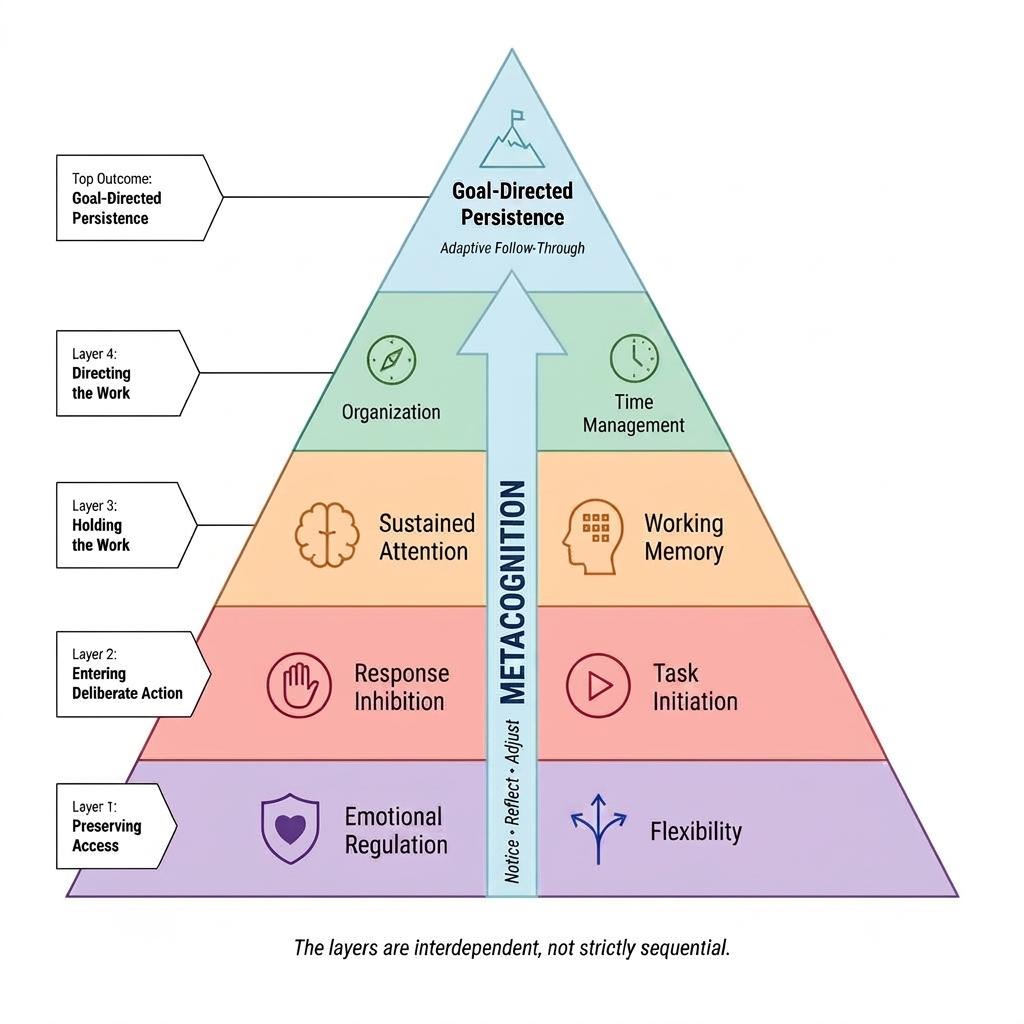
Executive-functioning skills are interconnected.
A student may need help regulating emotion and tolerating uncertainty while also learning how to begin, plan, organize, and sustain effort.
Metacognitive Mentorship™ runs through every layer. Coaches help students notice what is happening, understand where the process is breaking down, choose a response, and evaluate whether it worked. At first, the coach may carry more of the planning, language, or cognitive load. Over time, that thinking is transferred back to the student.
LET’S GET STARTED